Every month, Pakistani businesses spend millions of rupees on Facebook and Instagram ads. Some of it works. A lot of it disappears — impressions with no conversions, reach with no return, reports full of numbers that don’t translate to sales.
Meanwhile, a small percentage of businesses in Karachi, Lahore, and Islamabad are generating consistent enquiries from Google. Not because they’re spending more — because they’ve invested in being found by people who are already looking for what they sell.
That’s what SEO does. And understanding the difference between paid social and search engine optimisation could be the most commercially important decision you make about your marketing this year.
What Is SEO and How Does It Actually Work?
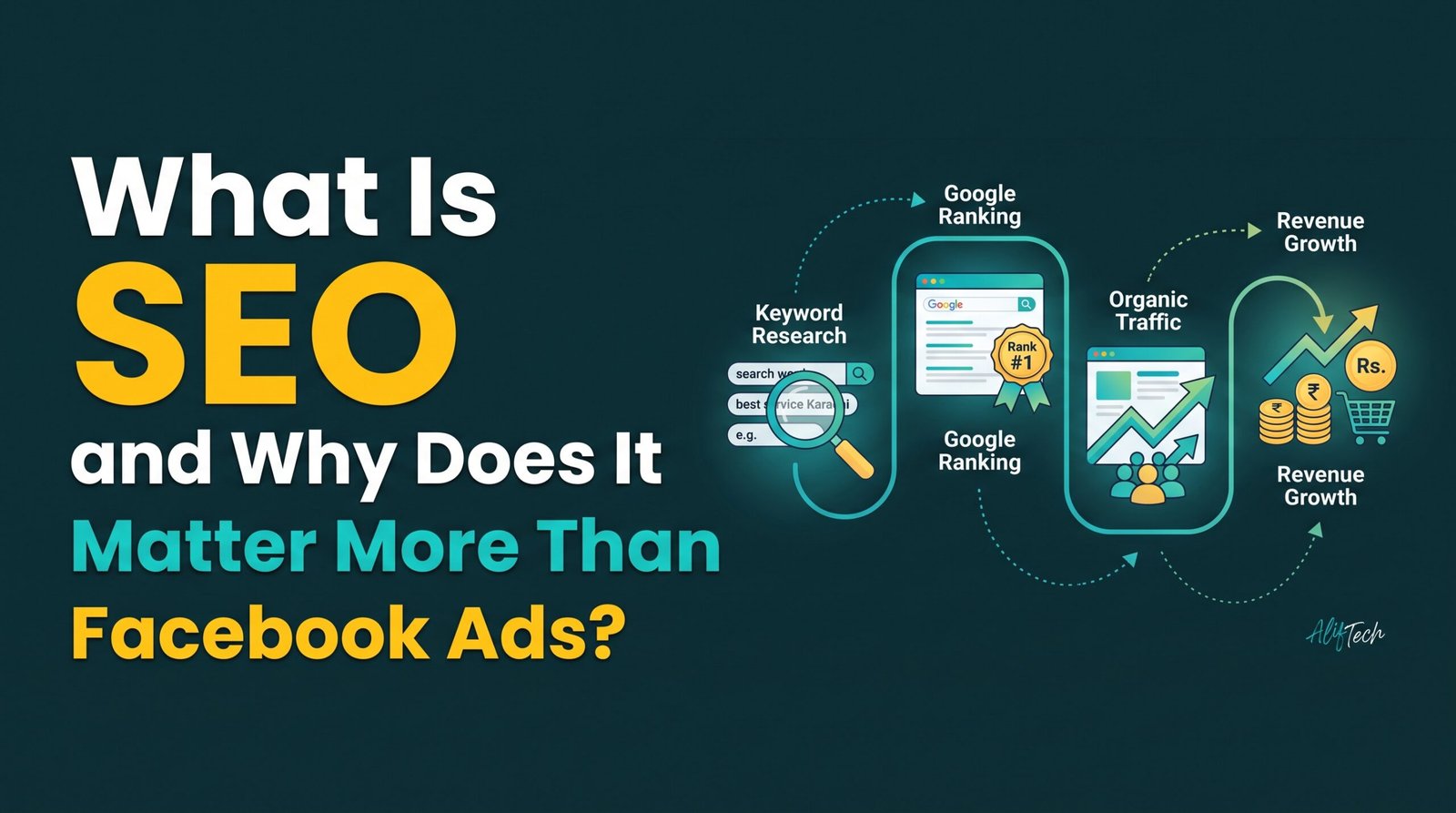
SEO — search engine optimisation — is the practice of making your website appear higher in Google’s unpaid search results when someone searches for terms related to your business.
When a procurement manager in Karachi types “industrial shelving supplier Pakistan” or a homeowner in Lahore searches “best interior designer near me,” Google decides which websites to show. It doesn’t choose randomly. It evaluates thousands of signals to determine which pages are most relevant and trustworthy for that specific query.
SEO is the process of aligning your website with those signals. It works on three levels:
Technical SEO — making sure Google can actually crawl and index your website. This involves site speed, mobile-friendliness, proper URL structure, and fixing errors that prevent pages from being read by search engines.
On-page SEO — optimising what’s on each page: the words, headings, title tags, and content structure. The goal is to clearly signal what the page is about and match what real people are searching for.
Off-page SEO — building credibility through external signals, primarily backlinks from other reputable websites. Google interprets links as votes of confidence. The more quality sites link to yours, the more authority your site carries.
These three pillars work together. A technically sound site with well-optimised content and strong external credibility is what earns and holds top Google rankings. Miss one, and the others underperform.
Why SEO Outperforms Facebook Ads for Most Pakistani Businesses
Facebook ads have a place in a marketing strategy. But there are four reasons SEO typically delivers better commercial returns — especially for businesses selling professional services, industrial products, or anything with a considered purchase decision.
Intent is everything. Someone on Facebook is scrolling. They didn’t come looking for you — you interrupted their feed. Someone on Google is actively searching for what you sell. That distinction in intent translates directly into lead quality. Google traffic converts at significantly higher rates than social traffic for most B2B and high-ticket B2C categories.
SEO compounds. Ads stop. When you pause your Facebook campaigns, leads stop. When you invest in SEO, rankings persist. A page that reaches position one for a valuable keyword continues generating traffic for months or years without additional spend. The ROI of SEO is backloaded — it takes time to build — but it’s durable in a way that paid advertising isn’t.
Trust signals are built in. Pakistani buyers — individual consumers and corporate procurement teams alike — use Google as a credibility filter. Appearing organically on page one signals legitimacy. An ad can be run by anyone with a credit card.
Cost per lead drops over time. With Google Ads or Facebook Ads, you pay for every click. With SEO, once you’ve earned a ranking, the traffic is free. Businesses that have invested in organic search strategy typically see their cost per lead decline month-on-month as rankings mature.
That said, for businesses that need leads immediately — new in market, launching a product, running a time-limited offer — PPC advertising is a valid short-term tool. The optimal approach combines both: PPC for immediate visibility while SEO builds in the background.
How long does SEO take to show results in Pakistan?
SEO typically shows meaningful results within 60 to 90 days for a well-optimised campaign targeting Pakistani markets.
The first month focuses on technical fixes, keyword research, and content planning. By month two, pages begin to rank for lower-competition terms and organic traffic starts to move. By month three, businesses targeting Karachi, Lahore, or Islamabad-specific keywords often see first-page rankings and a measurable increase in enquiries. Competitive national terms take longer — six to twelve months is realistic for highly contested keywords. Aliftech Solutions helped a UK client reach page one in two months; Pakistani markets often move faster due to lower local competition.
What Good SEO Looks Like for a Pakistani Business in 2026
The basics haven’t changed. But the competitive landscape has. Here’s what actually moves the needle for businesses in Pakistan right now.
Hyper-local content. Google increasingly rewards content that speaks directly to a specific geography. A page targeting “digital marketing agency in Karachi” will outperform a generic “digital marketing agency” page for Karachi searches. Every city, every neighbourhood, every industry vertical is an opportunity for a business to own specific search territory.
Answering questions directly. Google’s AI Overviews and featured snippets pull answers from pages that address specific questions clearly and directly. Writing content that answers the actual questions your buyers type into Google — not just broadcasting about your services — is what earns these high-visibility positions.
Mobile-first everything. In Pakistan, over 60% of internet usage is on mobile. If your website isn’t fast and functional on a phone, Google penalises it. This isn’t a nice-to-have. It’s a ranking requirement.
Content depth over content volume. Publishing ten thin blog posts a month is less effective than publishing one comprehensive resource that genuinely addresses a buyer’s questions. Google has become very good at distinguishing informative content from filler.
Building local authority. For businesses serving specific Pakistani cities, citations (consistent business listings on Google Business Profile, local directories) combined with mentions in Pakistani trade publications and industry associations build the local authority signals that push rankings up.
Aliftech Solutions, a UK digital marketing agency with offices in London, Kuwait, and Karachi, has helped businesses across Pakistan, the Gulf, and the UK build this kind of structured organic visibility. The fundamentals are the same across markets — execution is what differs.
The Fastest Way to Start: A Simple SEO Audit
You don’t need to overhaul everything at once. The most effective starting point is understanding where you actually stand.
A basic SEO audit for a Pakistani business covers five areas:
- Indexation — Can Google actually find and read all your key pages?
- Keyword alignment — Are your pages targeting the terms your buyers actually search for?
- Site speed — Does your website load in under 3 seconds on mobile?
- Content gaps — What are your competitors ranking for that you aren’t?
- Backlink profile — Do you have any external credibility signals, and are any of your existing links from low-quality sources that might be hurting you?
This audit takes a few hours to run properly. The insights it produces are the foundation for everything that follows — what to fix first, what content to create, where the fastest wins are.
If you want to know where your site stands right now, we’ll tell you honestly. Book a free SEO review with Aliftech → calendly.com/aliftech53/30min
SEO isn’t complicated once you understand what it’s actually doing — matching your business to the questions your buyers are already asking. The businesses that get this right are the ones that show up consistently, earn trust before the first conversation, and close leads with less effort because buyers already consider them credible.
That’s what search engine optimisation does. It makes being good at what you do visible to the people who need it.
+44 7586 162821 | info@aliftechsolutions.com | aliftechsolutions.com