

A big story breaks in your industry. By lunchtime, your competitors have posted about it. Your team is still asking the same question: “Should we say something too?”
Sometimes, yes. But only if you have something useful to say.
SEO newsjacking means publishing helpful, search-focused content in response to a relevant news story or announcement. The aim is to answer the questions your audience starts asking because something has changed.
For a business, that could mean explaining how a software update affects customers, what a new product launch means for buyers, or how an industry announcement changes a familiar process.
The opportunity comes from the gap between hearing the news and understanding what to do about it. A good article closes that gap.
What makes newsjacking useful for SEO?
Most content plans begin with questions people already ask. Newsjacking begins with an event that creates a new question, or changes an old answer.
Imagine a widely used ecommerce platform announces a change to its checkout experience. Store owners may immediately wonder whether their payment options, tracking or customer journey will be affected.
A general announcement tells them what changed. A useful business article explains what to check, who needs to act and what can wait.
That kind of article may attract relevant searches, earn citations or introduce your business to potential customers. None of those outcomes is automatic. A story can be popular without being relevant to your buyers, and a well-written article can miss the main wave of interest.
Treat newsjacking as one part of a broader content strategy. Your evergreen guides and service pages still need to do the steady work of explaining your expertise and helping people choose.
Start with the customer’s problem
Before opening a keyword tool, finish this sentence:
“Because of this announcement, our customers now need to understand…”
If the answer is vague, the topic probably needs more thought.
“Everyone is talking about it” is a reason to pay attention. It is not yet a reason to publish.
A marketing agency might reasonably explain a confirmed advertising-platform change. A furniture business might help buyers understand a newly announced material standard, once the details are verified. Neither needs an opinion on every celebrity story or viral argument.
This is where a planned SEO strategy helps: it gives each timely article a clear audience, a relevant search question and a place within your existing website.
Four checks before you cover a trending story
Use these checks to decide whether a topic deserves your team’s time.
1. Does it affect people you want to reach?
Be specific about who benefits. “Small businesses” is broad. “Online retailers reviewing their checkout setup” gives the writer a real reader to help.
2. Can you verify the important details?
Find the original announcement, documentation or research. Check the publication date, rollout dates, affected locations and any limitations. A feature being tested with selected users is different from one available to everyone.
3. Can you add something beyond a recap?
Your contribution might be an annotated example, a practical checklist, a comparison or a tested explanation. If the article only repeats the announcement in different words, readers have little reason to choose it.
4. Is there a useful next step?
The reader should leave knowing what to check, decide or do. Sometimes that next step is to get professional help. Sometimes it is simply to wait for more information.
If the story involves loss, distress or a vulnerable community, consider whether commercial commentary belongs there at all. A trend does not create an obligation to participate.
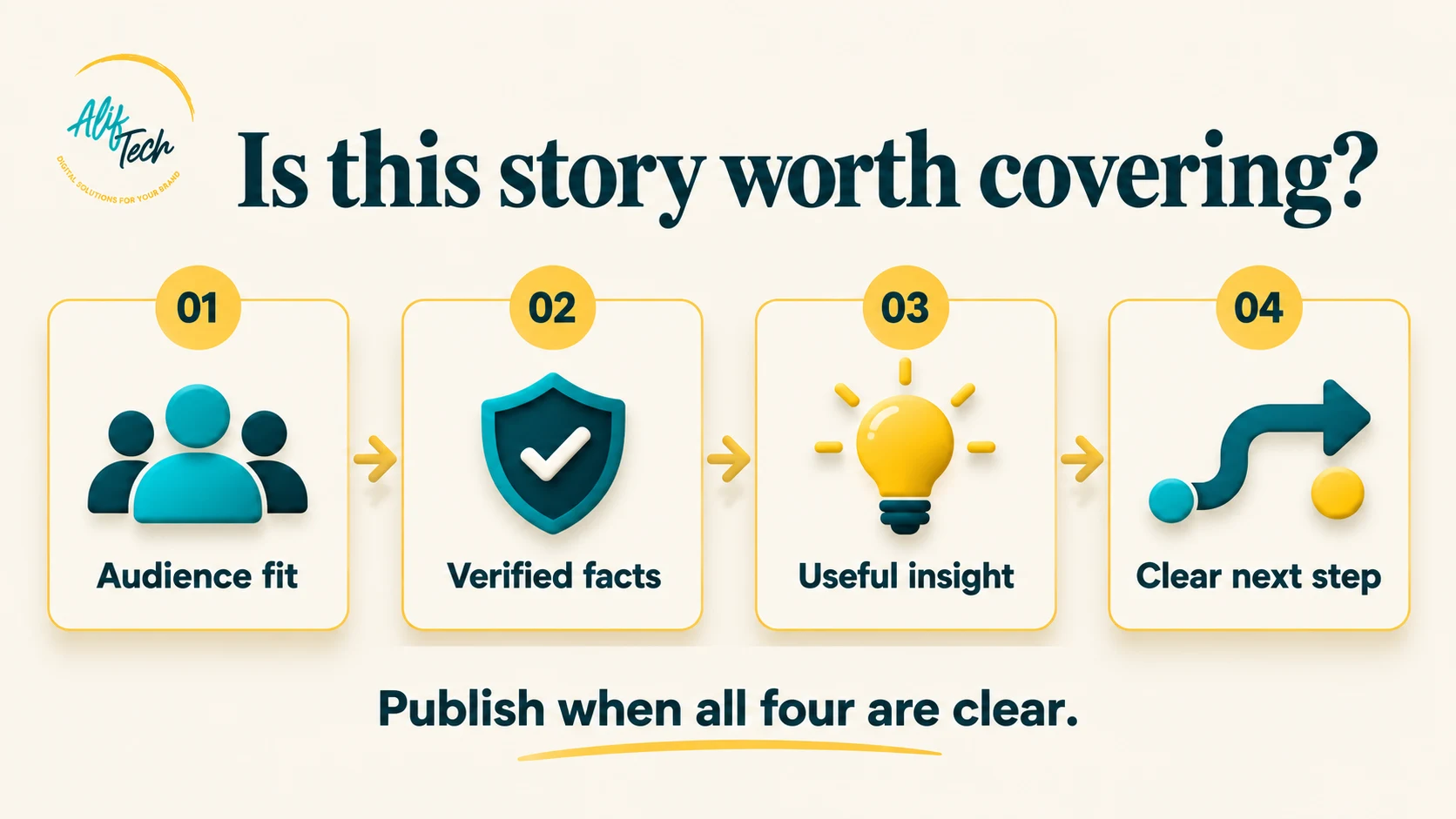
Choose a story because you can help the reader make sense of it.
How to find relevant newsjacking opportunities
Keep your monitoring narrow enough to be useful. Start with the official blogs, release notes and industry publications your team already relies on. Add customer questions from sales calls, support enquiries and relevant professional communities.
Those conversations are particularly valuable. The announcement may be everywhere, but the customer’s actual concern can be surprisingly specific.
Use Google Trends to explore whether interest is rising in your target market and which related questions appear. Its standard interest scores are relative, scaled from 0 to 100; they are not monthly search totals. A peak does not tell you how many potential customers are searching. Google explains how Trends data works.
Scheduled events also deserve a place in your calendar. Product launches, industry reports and conferences give you time to prepare research and article outlines. Keep the conclusions open until the actual announcement is available.
Choose a search question you can answer well
The name of the news story is often too broad to be your best target. Look for the question that connects the announcement to a decision your reader needs to make.
For a hypothetical checkout update, possible questions might include:
- What does the checkout update change for existing stores?
- Which settings should store owners review?
- How can a business test its purchase journey after the update?
These are illustrative angles, not claims about a current platform release.
Read the search results before choosing your approach. Are people being shown announcements, tutorials, comparisons or troubleshooting pages? That tells you something about the information they are likely seeking.
New queries may have little historical keyword data. Use the original announcement, current search results and customer language together. Avoid inventing search-volume figures to make a topic sound more attractive.
Write the article around a useful answer
A practical newsjacking article should make the reader feel oriented quickly. They should not need to work through several paragraphs of industry excitement before learning whether the story affects them.
Open with what changed and who should care
Explain the confirmed change, the people it affects and the most useful immediate action. Put important qualifications near the claim they qualify.
If availability varies by country or account type, say so early. If the details are incomplete, make that clear.
Separate the announcement from your interpretation
Readers need to know which statements come from the original source and which are your analysis. Phrases such as “the announcement confirms” and “our recommendation is” make that distinction easy to follow.
Link directly to the source so readers can check the details themselves.
Show what the change looks like in practice
A checklist or worked example can be more useful than another page of commentary. Explain a realistic situation, identify the decision and show how the reader could approach it.
Do not turn an imagined example into a client success story. Label hypothetical situations and keep any real performance claims tied to evidence.
Answer the question completely
An article about a small update may be brief. A complex change may need screenshots, exceptions and several examples. Let the reader’s needs determine the length.
Google’s guidance on helpful content encourages content created to serve people. A practical way to apply that here is to ask: would this page still help a customer if it received no search traffic?
Optimise the page without making the writing awkward
Use a descriptive title that combines the subject with a clear benefit. For example, “Checkout Update: What Store Owners Should Check” tells the reader more than a dramatic headline about everything changing.
Include your main topic naturally in the title, opening and a relevant heading. Related language should come from explaining the subject properly, rather than working through a list of phrases to repeat.
Before publishing, check that:
- The page has one clear main heading and descriptive subheadings.
- The title and meta description accurately describe the article.
- The URL is readable and avoids unnecessary date references.
- Images have descriptive filenames and useful alt text.
- Sources and internal links work.
- The page is readable on a phone and available for indexing.
- The author and publication date are accurate.
Google’s SEO Starter Guide provides the underlying guidance for titles, links, images and site accessibility. These basics help search engines understand your content; they do not guarantee a particular ranking.
If publishing exposes problems with mobile layouts, page templates or enquiry forms, address those through your website development work. A timely article still needs a usable website behind it.
Link to services at the point where readers need help
Internal links work best when they answer a natural follow-up question.
Someone reading about keyword selection may want help planning search content. Someone learning how to distribute an article may need a coordinated social content plan. Give each reader the relevant route, using anchor text that explains the destination.
For example, when turning a timely article into platform-specific posts, social media marketing support can help connect the article to a wider publishing plan.
You do not need to link every service your business offers. A few relevant links give readers clearer choices than repeated sales interruptions.
Also consider linking to the new article from a related existing guide. That helps people browsing your established resources discover the timely explanation.
Publish promptly, then help the right people find it
There is no universal two-hour deadline. Some stories move quickly; others create questions that last for weeks. Judge the opportunity by the audience’s need, the pace of the story and your ability to provide an accurate answer.
Prepare the parts you can in advance: a page template, source checklist, image style and clear responsibility for approval. This makes it easier to respond without skipping fact-checking.
Once published, share the most useful takeaway in the channels your audience uses. A LinkedIn post might explain the business implication. An Instagram carousel might turn the article into a short checklist. An email might highlight the action existing customers should consider.
Use campaign tags on external promotional links where appropriate. Keep internal website links free of campaign tags so they do not complicate attribution.
You can request indexing through Search Console for a URL you manage, but that is not a fast-track promise. Google states that crawling can take days to weeks and that requesting a crawl does not guarantee inclusion. Read Google’s recrawling guidance.
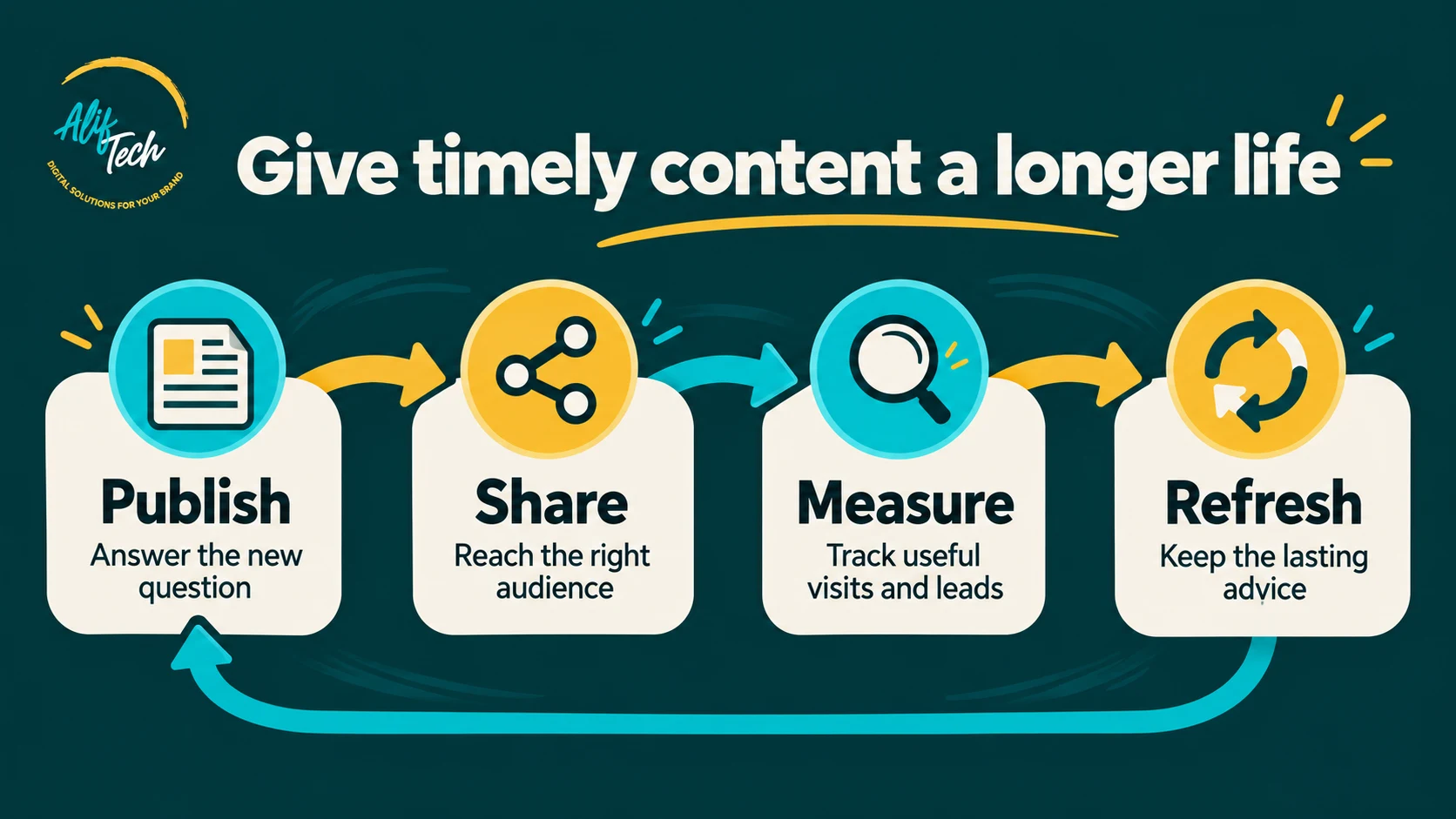
Plan the follow-through before the first version goes live.
Measure whether the attention was useful
A busy traffic chart can hide a weak business result. Decide what success means before publishing.
| Question | What to review |
|---|---|
| Did the article reach relevant searches? | Search Console queries, impressions and clicks for the page |
| Which promotion brought readers? | Analytics landing-page and acquisition reports |
| Did readers explore relevant help? | Measured clicks to service pages and other useful resources |
| Did the content produce real enquiries? | Confirmed form submissions, booked calls or sales records |
| Did others find it worth citing? | Relevant editorial mentions and referring websites |
Check early performance, then review again after the initial interest settles. Compare results with similar content and account for other promotions running at the same time.
Keep reported conversions separate from verified enquiries. A tracked button click tells you someone expressed interest; it does not prove a form reached your inbox or a sale happened.
Keep the useful parts after the story moves on
When the initial attention fades, revisit the page. Correct changed details, replace temporary advice and make outdated information obvious.
Sometimes the article can develop into a lasting guide. An explanation of a platform announcement, for instance, might become a more complete checklist for reviewing the affected process.
Use an updated date when you make a meaningful revision. Keep the original publication date honest. Readers should be able to understand when the advice was written and whether it still applies.
SEO newsjacking FAQs
Can a small business use SEO newsjacking?
Yes. Start with a development that affects your own customers and answer one specific question well. You do not need to compete with national publishers on the headline itself.
How quickly should a newsjacking article be published?
Publish while your answer is useful and the facts are sufficiently clear. The right timing depends on the story. Accuracy and a relevant contribution matter more than following a fixed deadline.
Does newsjacking guarantee backlinks or higher rankings?
No. It creates an opportunity to be helpful while interest is growing. Search visibility and editorial links depend on the content, the website, the competition and whether other people find the contribution valuable.
Can AI help write timely content?
It can help organise research, explore an outline or edit a draft. A responsible editor still needs to verify sources, dates, quotations and recommendations, then add the knowledge that makes the article useful.
Should every trending story become a blog post?
No. Some topics fit a brief customer update or a social post. Others deserve no response from your brand. Choose the format according to what the reader needs.
Turn a relevant moment into a helpful resource
The strongest reason to cover a story is simple: your customers need help understanding it, and you can provide that help.
Start with their question. Verify the change. Explain the practical consequence. Then give them a sensible next step.
If your business needs a clearer plan for finding those opportunities and connecting them to useful website content, explore Aliftech’s SEO services.